
About Us
Indigenous Land + Peoples Acknowledgement
Sick + Twisted Theatre acknowledges that our work and performances take place on Treaty One Territory - the traditional lands and waterways of the Anishinaabeg, Cree, Anisininew, Dakota, and Dene Peoples and the homeland of the Metis Nation. We respect the treaties made here. We acknowledge that Indigenous culture and art forms thrive on these lands despite having been criminalized by the forces of colonization.
We acknowledge that people with disabilities or gifts among Indigenous communities continue to be criminalized, institutionalized, and denied care. As we create art that centres the perspective of Deaf and disabled artists, we seek to live in good relationship with the traditional caretakers of this land, respecting the wisdom of Indigenous culture.
About Sick+Twisted Theatre
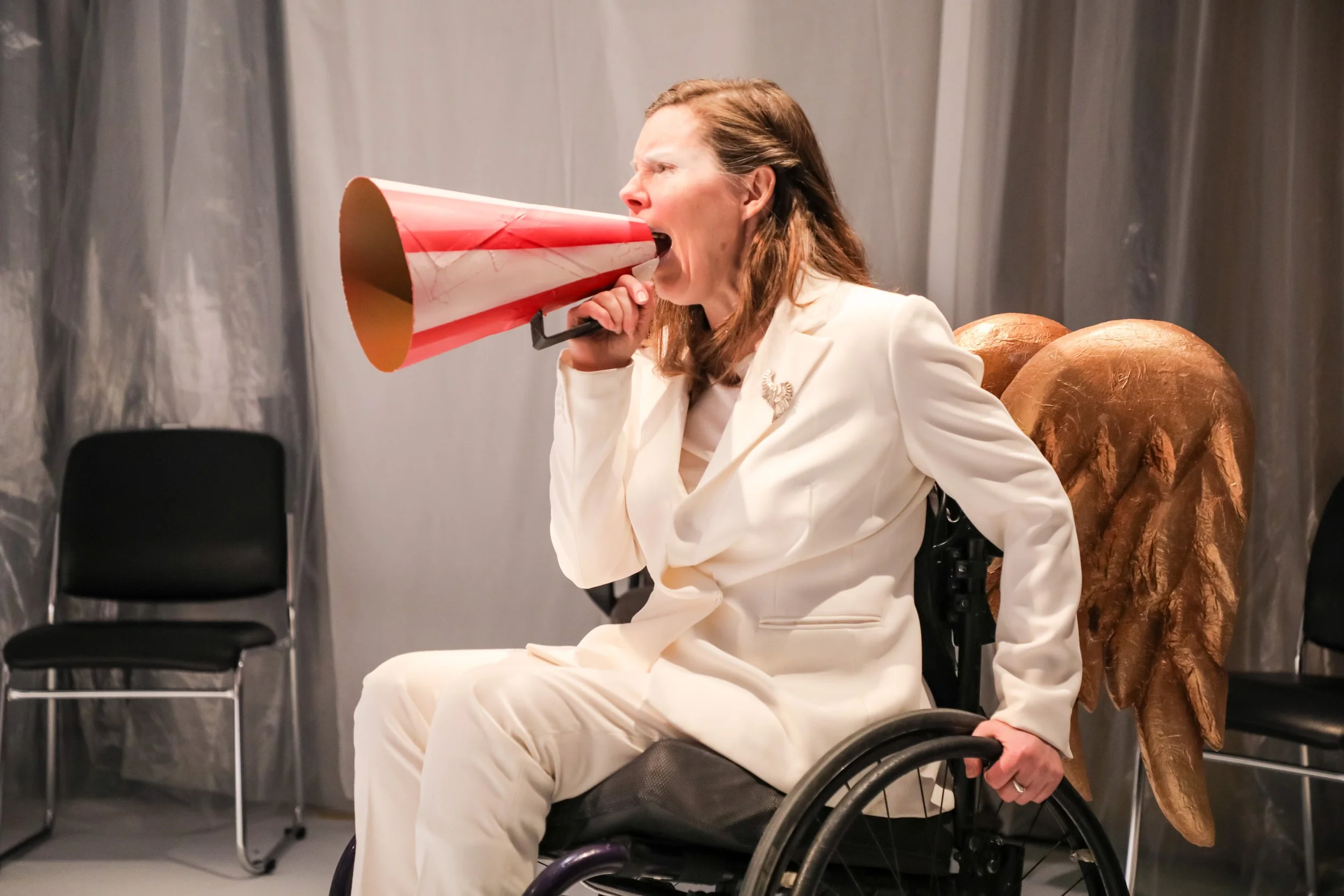
All performance is rooted in the body and the exploration of the human condition, yet artists with disabilities are grossly underrepresented in the creation and presentation of theatre in Canada. Artists with disabilities have an understanding of the truths of the human condition that can only be arrived at by confronting the challenges and opportunities presented to us by our exceptional bodies. But these truths are universal. We have what the rest of the world needs.
Sick + Twisted recognizes that the ability to perceive and represent truth in performance is not dependent on body/mind “perfection”. Artistic excellence is achievable by artists of all body/minds and abilities.
Beliefs, Core Values And Philosophy
We believe that artistic excellence is achievable by people of all abilities: the rigorous exploration of complex ideas through a sophisticated aesthetic does not require bodily perfection or neuro-normativity.
We believe that stories about disabled people need to be told by disabled people, otherwise the stories lack accuracy and authenticity.
We believe theatres who extend access supports to their audiences (wheelchair seating, ASL interpretation, live audio description) have an obligation to represent disability on their stages, otherwise they will be guilty of inviting disabled people to come and see imaginary worlds where we are erased from existence.
We believe the theatre can be made in ways that respect the basic human needs of the practitioners.
We believe that all bodies are watchable, all bodies tell a story, and that a narrow definition of beauty hinders us all.
We believe that unacknowledged, internalized able-ism is a limiting belief in most people’s lives and that art created from our lived experience of disability can liberate audiences from this limitation.
We’re here to create something of value for an audience. They’ve come here looking for something, they don’t know what it is, but we want to make sure they leave with it. Our job is to find it and give it to them.
Aesthetic/Curatorial Framework
Our tagline is “Theatre for anyone with a body”. We don’t create theatre for disabled people, we create theatre for everybody. We believe that there are deep universal truths of the human condition hidden behind the veil of disability.
We believe our bodies tell the truth and when we listen clearly and with curiosity, we can create work that reveals an audience to itself. We can help the audience find the parts themselves they didn’t know they were missing.
We want our work to be accessible, in form and content.
We seek collaboration with other organizations in order to expand Crip joy to an ever-increasing circle of partners, allies and co-conspirators.
We extend invitations outward to the community in order to constantly seek out new artists who need to connect with our organization and who our organization needs connect with.
Working Values
Every individual has gifts they bring to every project, and our work is better when those gifts are shared, recognized, and embraced.
We know that we all do our best work when we feel safe, supported and seen. We create conditions where that can happen.
We are committed to practices that promote inclusion. We make time in rehearsal for check ins or checkouts. We embrace Crip time, recognizing that not everything can get done on schedule and it’s not the end of the world.
We are responsible stewards of the public funds we are given while balancing a commitment to paying everybody well.
Overarching Goals
We want to change the way we think about disability in our society. We know that stories shape our beliefs and beliefs guide our actions. If we can change the stories we tell about disability, our beliefs about disability will change.
We believe that able-ism hurts us all. It makes our value as human beings contingent on our ability to produce, to work. It makes our very existence transactional. It makes us ashamed of our own little weaknesses or impairments that don’t quite rise to the level of disability but nevertheless seem shameful. It makes us hide parts of ourselves that we don’t want others to see because of that shame. It makes us uncomfortable to ask for help when we need it, believing that asking for help means that you are weak and a burden to others, rather than merely human. Dismantling able-ism means changing the social contract in our society for the better.
Capitalism tells us that our worth as human beings is entirely dependent on our ability work or produce or generate wealth in some form. But our bodies tell a different story. We know that we are happier, more fulfilled and of greater value to others when we are active participants in a strong web of interdependent relationships. While most of us are eager to help when help is required, we feel shameful or are reluctant to ask for help when we need it. We cannot build that strong web of community if no one admits that they need help. If the stories we tell can help change that social contract in order to normalize the act of asking for help, we can transform the world into a better place.
But to really tell that story, we have to change the way theatre is made.
We believe that everyone does their best work when they feel safe, supported and seen. We believe that creating conditions where artists can bring their full selves into the work improves the work we actually do. We believe that creating an ensemble among collaborating artists doesn’t just happen on its own, it needs to be guided through a rigorous commitment to interdependence throughout the workshopping, developing, rehearsal and performance process. Part of the way we do that is by normalizing asking for help. By building in moments where that can happen: through check-ins at the beginning of the day and check- outs at the end of the day, we create a culture of interdependence. We believe that the best work is created by strong ensembles.
Like any effort rooted in social justice, we are working towards our own obsolescence. We want to see disabled artists engaged at every level in the professional theatres of this country, ideally in numbers that reflect the ratio of disabled people in our population. We recognize that the destination of this journey is very very far away: so far that we may never actually get there. But holding this goal at the centre of what we do keeps us moving in the right direction.
Measures Of Success
Although our overarching goals, like changing the way theatre is made and transforming society’s perception of disability, are very big, most steps toward that goal are tiny and incremental. Transformation actually happens one relationship at a time. Thus the measures of our success are often tiny moments.
Every now and then we get a glimpse of that transformation:
When we see disabled artists we have worked with in the past producing their own work with a rigorous commitment to access, we know we’ve been successful.
When major theatre organizations ask us to support their application for funds to make their backstage and rehearsal spaces more accessible, we know we are successful.
When families return again and again to our Panto productions, telling us it has become part of their holiday tradition, we know we are successful.
When other companies approach us about collaborating on a project as coproducers, we know we are successful.
When actors with disabilities are cast in plays in mainstream theatres, especially when those roles do not require disability, we know we are successful.
When “the vibe” in rehearsal shifts and we see a company of actors become a cohesive unit, an ensemble, an interdependent community, we know we are successful.
When audiences tell us how much our work means to them, we know we are successful.
When we create conditions where a group of artists with many different disabilities, abilities or gifts all have their access needs met so that they feel safe, supported and seen, we know we are successful.
When disability issues crop up, interrupting our carefully made plans and we all respond with curiosity rather than frustration, we know we are successful.